Project Management

Good task management is supposed to be the thing that keeps your marketing campaigns on track. But here is the uncomfortable truth most small marketing teams discover too late: the system you built to stay organized might be the very thing slowing you down. If your task tracking lives across a shared Google Sheet, a Slack thread, a few email chains, and a folder of "final_v3_APPROVED" files, you do not have a system — you have organized chaos wearing a productivity costume.
For SMB marketing managers running campaigns with a lean team of one founder, a couple of freelancers, and maybe a part-time designer, task coordination is not a nice-to-have skill. It is the difference between a campaign that ships on time and one that quietly falls apart two days before launch because someone approved the wrong version in a DM that nobody else can find. The stakes are real, the margins are thin, and the tolerance for workflow breakdown is basically zero.
This article is about diagnosing the specific ways a patchwork task workflow disguises itself as a functioning system — and what a leaner, smarter approach actually looks like in practice.
The Campaign-Day Scenario That Should Sound Familiar
Picture this: it is the Monday morning of your product launch week. The paid social creative needs final sign-off from the founder. The email copy is sitting in a Google Doc with three comment threads — two resolved, one that just says "thoughts?" from eight days ago. Your freelance copywriter is messaging you on WhatsApp asking which version of the landing page headline you went with. You cannot remember. Neither can she. The approval you got was verbal, on a Zoom call, and nobody wrote it down anywhere.
This is not a communication problem. This is a task management problem. Every individual piece existed somewhere, but the task workflow had no spine — no single place where status, approval, and context lived together. So when launch day arrived, you spent the first two hours not executing the campaign, but reconstructing what had already been decided.
Where Task Management Actually Breaks Down
Most small marketing teams do not lack effort or intelligence. They lack a coherent task coordination layer. According to Asana's Anatomy of Work report, workers switch between apps an average of 10 times per hour trying to track work — and the switching itself kills focus and context. For a two-person marketing team juggling a product launch, three social campaigns, and a newsletter, that fragmentation is fatal to momentum.
The Approval Black Hole
Approvals are where most task workflows collapse first. The creative goes to the founder via email. The founder replies with notes in a separate thread. The freelancer gets the brief via chat. Three people have three different versions of what "approved" means, and none of it is attached to the actual task. This is not a one-time failure — it is a structural one baked into how the team manages work.
The Context Gap Between Chat and Tasks
When the conversation about a task lives in one place and the task itself lives somewhere else, context falls through the cracks every single time. A decision made in Slack at 2pm on Tuesday is invisible to the freelancer who picks up the work on Thursday morning. She has to ask. You have to search. Time burns while the campaign waits.
The Spreadsheet Illusion
Shared Google Sheets feel like task tracking. They look like task tracking. But they are static snapshots that nobody updates consistently, have no notification logic, and carry zero accountability. Harvard Business Review research has highlighted how "work about work" — status updates, tracking down information, chasing approvals — can consume more than 60% of a knowledge worker's day. Your spreadsheet is a major contributor to that number.
Task Management Problem | Where It Shows Up | Real Cost to Your Team |
|---|---|---|
Approval with no paper trail | Email, DM, verbal Zoom | Wrong version goes live |
Context stored in chat only | Slack, WhatsApp, Teams | Freelancers re-ask, teams re-explain |
Status tracked in spreadsheets | Google Sheets, Notion tables | Always out of date, never trusted |
Feedback scattered across tools | Email + doc comments + chat | Conflicting edits, missed revisions |
The Repeatable Play: A 6-Step Task Management Workflow for Lean Marketing Teams
You do not need a complex PM tool with 47 fields and a Gantt chart. You need a lightweight task workflow that your founder can use without training and your freelancers can follow without a manual. Here is the play that works consistently for small marketing teams.
One campaign, one task board. Every campaign gets its own dedicated task tracking space — not a folder, not a channel, not a doc. A space where tasks live, statuses update, and files attach directly to the work they belong to.
Every task has an owner and a due date. No exceptions. "Team will handle this" is not task coordination — it is a polite way of saying nobody owns it. Assign every single task to one person with a hard deadline before the campaign kicks off.
Attach approvals to the task itself. When the founder reviews copy, that feedback and sign-off lives inside the task — not in a separate email thread. This is the single highest-leverage change a small team can make to their task management workflow.
Brief your freelancers with context, not just instructions. Every task assigned to an external collaborator should include the campaign goal, the audience, the format spec, and any prior feedback — right there on the task card. This eliminates the "just to clarify" messages that slow everything down.
Daily 5-minute task check-in, async. Instead of a standup meeting, each team member drops a quick status update on their open tasks every morning. This replaces the reactive "hey, where are we on X?" messages that fragment everyone's focus.
Post-campaign task audit. After every campaign, spend 15 minutes reviewing which tasks slipped, which approvals got stuck, and where context was lost. Build that fix into the next campaign's task workflow before you start it.
Where Marketing Teams Lose Time Per Campaign Week
41%
Chasing approvals
35%
Clarifying task scope
24%
Finding old files
Fig 1: Estimated time lost per campaign week due to disorganized task coordination (illustrative)
Common Failure Points in Task Management (And How to Dodge Them)
Even teams that build a smart task workflow run into the same recurring problems. Here is what to watch for — and the specific fix for each.
Failure Point 1: The Founder Bottleneck
The founder is the final approver on almost everything, but they are also running a company. If your task coordination requires them to find a file, open an email, locate the right version, and reply with feedback, approvals will be late every single time. Fix this by bringing the approval request directly to them — one link, one task, one clear ask. Make it frictionless or it will not happen on time.
Failure Point 2: Freelancers Working Without Context
A freelancer who does not understand the campaign goal will deliver work that technically meets the brief but misses the point. Good task tracking means every task card includes the "why," not just the "what." According to McKinsey research on workplace communication, unclear information is one of the top drivers of rework — and rework is the enemy of a lean team's deadline.
Failure Point 3: Tasks That Live Only in Someone's Head
If it is not written down in your task management system, it does not exist as a trackable deliverable. Verbal agreements in standups, promises made in casual Slack messages, and "I'll handle it" moments in all-hands calls are all liabilities waiting to become missed deadlines. Every commitment becomes a task, or it becomes a problem.
Failure Point 4: Tools Multiplying Without a Home Base
The average SMB marketing team runs work across five or more separate tools. Each new tool feels like a solution. Collectively, they become a coordination problem. The fix is not always fewer tools — it is having one place where task status, communication, and files connect rather than scatter.
How Morningmate Brings Task Management, Approvals, and Chat Together
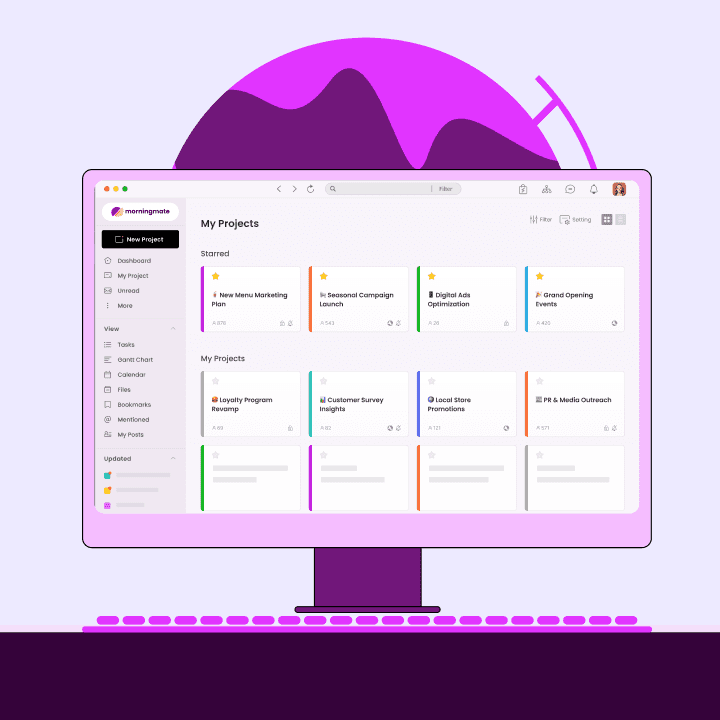
This is where Morningmate does something genuinely useful for lean marketing teams. Rather than asking you to add another layer to your existing stack, Morningmate is a lightweight work management tool that connects task tracking, built-in chat, and file management in a single workspace — without the steep learning curve of something like Jira or Asana.
Here is a worked example. You are running a product launch campaign. You create a campaign project in Morningmate and build out the tasks: landing page copy, email sequence, paid social creative, founder approval. Each task gets an assignee, a due date, and a brief attached directly to it. Your freelance copywriter gets access to her specific tasks — no need to wade through the entire project, just her work, with full context visible.
When the landing page copy is ready, she marks it complete and the founder gets notified. The founder can drop feedback and approval directly inside the task using Morningmate's built-in chat — so the entire conversation about that deliverable stays attached to it permanently. No separate email thread. No lost DM. No "wait, which version did we go with?"
The Feed view in Morningmate also works like a social media timeline — posts, updates, and file shares all flow in one stream that everyone on the team can see. This means your founder can scan what is moving without attending a single extra meeting, and your freelancers stay informed without being added to channels they do not need. It is the kind of task coordination built for small teams that actually need things to stay simple.
Morningmate is used by 550,000 teams globally — and the reason it sticks with lean teams specifically is that there is nothing to configure before you can start. It works the way your team already thinks, without forcing anyone to learn a new system just to track who owns what.
Task Workflow Step | Scattered Approach | Consolidated Task Management |
|---|---|---|
Campaign briefing | PDF via email, verbal on Zoom | Brief attached to task card, visible always |
Freelancer coordination | WhatsApp + email + shared drive | Assigned task with files and context in one place |
Founder approval | Email thread, often delayed | Notification on task, feedback in built-in chat |
Campaign status check | Manual Slack messages to team | Live task board visible to all stakeholders |
Post-campaign review | Scattered notes, incomplete memory | Full task history with comments and files archived |
Campaign Delivery Rate: On-Time vs. Missed Deadlines by Workflow Type
48%
Scattered tools (on time)
67%
Single PM tool (on time)
89%
Unified task + chat workspace (on time)
Fig 2: On-time campaign delivery rate by task coordination method (illustrative)
Your Task Management Checklist to Apply This Week
You do not need to overhaul everything at once. Start with these seven moves this week and your task coordination will look fundamentally different by Friday.
✅ Audit your current task management tools. List every place a task, approval, or campaign-related decision currently lives. Count them. If you hit five or more, you have a fragmentation problem.
✅ Pick one task tracking home base for your next campaign — not a chat tool, not a spreadsheet. A real task board with assignees, due dates, and file attachment.
✅ Write a one-paragraph brief for every freelancer task before you assign it. Include the goal, the audience, the format, and any prior feedback. Attach it to the task card.
✅ Establish a single approval path. Every piece of creative goes through one review channel, in one place, with the feedback recorded on the task itself — not in a separate thread.
✅ Assign every open task to one person. Go through your current campaign board and eliminate any task that has no single named owner. Either assign it or cut it.
✅ Replace your next status-check message with a shared task board view. Let the board answer "where are we?" so you can save that message for things the board cannot tell you.
✅ Schedule a 15-minute task audit after your next campaign wraps. Document what slipped and where — and build that fix into the next campaign's task workflow before kickoff.
Organized chaos is seductive because it looks like a system. It has folders and labels and color-coded sheets. But task management that actually works does not just organize your work — it connects your work, your people, your context, and your decisions in one place where nothing can fall through the gap. That is the difference between campaigns that launch clean and campaigns that launch with a prayer. Build the real system this week, and you will feel it by the next deadline.