Project Management

Good task management is easy to overlook — right up until the moment your operations manager books two weeks of annual leave and the whole team grinds to a halt. If you run a small business, you know this feeling. One person walks out the door and suddenly nobody knows which client approvals are pending, which supplier needs chasing, or where that important file is saved. Work does not pause because someone is on holiday. The chaos that follows is not a people problem. It is a systems problem.
For most small businesses with five to fifty people, key team members hold an enormous amount of operational knowledge in their heads — or buried in their personal inboxes. Task tracking lives across a dozen different places: sticky notes, WhatsApp threads, email chains, and verbal agreements from last Tuesday's standup. When that person leaves for even a week, the gaps become immediately visible.
This article breaks down exactly what breaks first, why it keeps happening in lean teams, and what practical steps you can take today to make your business genuinely resilient — without adding headcount or expensive software.
What Actually Breaks First (And Why It Costs Real Money)
The first thing to collapse is task visibility. Nobody knows what was in progress, what was blocked, or what was promised to a client. According to Harvard Business Review, knowledge loss from employee absence is one of the most underestimated operational risks in small organizations, because the disruption is cumulative and often invisible until a deadline is missed or a client complains.
Here is what typically breaks in the first 48 hours after a key team member goes on leave:
Active task coordination stops. Work in progress has no owner. Colleagues either duplicate effort or avoid touching it entirely.
Approvals and decisions stall. Only the absent person knew the status or had the relevant context.
Client-facing commitments get missed. Deadlines that were tracked informally — in someone's head or a personal chat — fall through.
You get pulled back in. As the owner, you become the fallback for every question, undoing any delegation you had built.
Each of these failures carries a direct cost. Missed deadlines erode client trust. Duplicated work burns billable hours. And you spending half a day on urgent firefighting instead of running the business? That is the most expensive outcome of all.
What Breaks | Immediate Impact | Longer-Term Cost |
|---|---|---|
Task tracking | Nobody knows what is in progress | Missed deadlines, duplicated effort |
Approvals and decisions | Work stalls waiting for sign-off | Delayed deliverables, client frustration |
Institutional knowledge | Context sits in one person's inbox | Team makes uninformed decisions |
Owner time | You become the fallback for everything | Strategic work stops entirely |
Why This Keeps Happening: The Real Root Cause
This is not about lazy team members or bad handovers. The root cause is simpler: task management in most small businesses is person-dependent rather than system-dependent. Work lives inside individuals rather than in a shared, visible place.
A Gallup workplace study found that employees spend an average of 20% of their working week searching for information or tracking down colleagues to answer questions that should already be documented. In a ten-person team, that is two full-time equivalents lost every single week — not to absence, but to poor task coordination habits that exist even when everyone is present.
When task tracking is informal, it is invisible. No one person is trying to create a single point of failure. It just happens naturally when tools are scattered and there is no expectation that work be documented in a shared place.
Where Small Teams Store Active Task Information (% of teams)
61%
Personal email / inbox
48%
WhatsApp / chat apps
22%
Shared task system
Fig 1: Most small teams store active work in personal tools with no shared visibility (illustrative, based on SMB workflow research)
A Practical Fix: Build Coverage Into Your Task Management System
The good news is that this is a solvable problem, and it does not require a big overhaul. You need three things working together: a single place for task tracking, clear ownership that transfers when someone is absent, and enough context attached to each task that anyone can pick it up.
Step 1: Move Task Management Out of People's Heads and Inboxes
Every active piece of work — client deliverables, internal projects, recurring responsibilities — needs to live in one shared place. Not in a personal inbox, not in a WhatsApp thread that only two people can see. A shared task workflow tool that the whole team accesses.
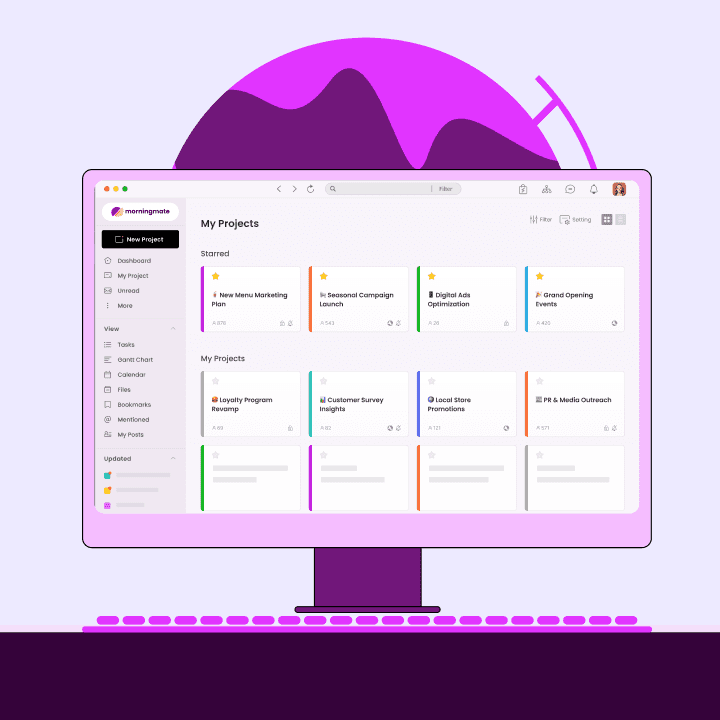
This is where tools like Morningmate remove friction. It gives your team a single workspace where tasks are created, assigned, and tracked — with a feed-style interface that even non-technical team members pick up within minutes. Unlike heavyweight project management tools that require training and admin, Morningmate is built for teams that just need work to be visible without a steep learning curve.
Step 2: Attach Context to Every Task
A task that says "Follow up with client" is useless to a colleague covering during leave. Task management only works as a continuity tool when tasks include enough context for someone else to act. Build this habit across your team:
Include the relevant files, links, or reference documents directly in the task
Write a one-line note on where things stand and what the next step is
Tag the deadline and the person it is waiting on
Morningmate lets you attach files and leave notes inside each task, so the full picture travels with the work — not with the person.
Step 3: Assign a Cover Owner Before the Leave Starts
At least two business days before anyone goes on leave, the departing team member should formally reassign or flag their active tasks. This is not a verbal briefing — it is a structured handover in your task tracking system. Every task gets a temporary owner. Nothing should be sitting unassigned.
Step 4: Give the Team One Communication Channel, Not Five
Questions during absence usually fall into chaos because there is no single place to ask them. Morningmate's built-in chat — which works like WhatsApp but is tied directly to projects and tasks — means conversations stay connected to context. The cover person is not hunting across four apps to piece together what was agreed.
What Good Task Management Coverage Looks Like in Practice
Here is a quick comparison of how a planned two-week leave period plays out with and without a proper task management system in place.
Situation | Without a Shared Task System | With Structured Task Coordination |
|---|---|---|
Day 1 of leave | Team does not know what was in progress | All tasks visible, cover owners assigned |
Client deadline mid-leave | Missed or owner is called on holiday | Cover person completes with task context |
Owner questions during leave | Escalate to you every time | Team resolves using task notes and files |
Return from leave | Hours spent catching up on what happened | Full task history visible in minutes |
According to McKinsey research on organizational knowledge management, teams that use structured task tracking tools recover from knowledge disruptions significantly faster than those relying on informal communication. For a small business, faster recovery translates directly into client retention and owner sanity.
The Tool Sprawl Problem: Why One Hub Beats Five Apps
A common reaction from SMB owners at this point is: "We already have too many tools." That concern is completely valid. Adding a project management platform that requires onboarding sessions, admin setup, and monthly per-seat fees just shifts the problem.
The goal is not more tools — it is one tool that replaces the scattered ones. Morningmate is built specifically for this: it combines task management, file sharing, and team chat in one lightweight workspace that costs a fraction of maintaining separate subscriptions for each. There is no steep learning curve because the interface mirrors what your team already knows from social media feeds and messaging apps. Over 550,000 teams use it precisely because it does not require a dedicated project manager to set up or maintain.
If your team is currently running task tracking across email, WhatsApp, and spreadsheets, consolidating into a single tool like this is not adding complexity — it is removing it. You can learn more about how to set up task management for a lean team without overengineering the process.
Team Recovery Speed After Key Member Leave (% of tasks back on track within 48 hours)
24%
No task system
55%
Partial task tracking
87%
Centralized task management
Fig 2: Teams with centralized task management recover significantly faster when key members are absent (illustrative)
Your Next Step: Make Task Management the Foundation, Not the Afterthought
Here is the honest takeaway: your business's resilience to any kind of disruption — leave, illness, sudden departure — is a direct reflection of how well your task management works day to day. If tasks live in one visible, shared place with clear owners and context, your team handles absence without dragging you back in. If tasks live in people's heads and personal apps, every absence becomes a crisis.
The ROI on fixing this is concrete. You stop losing hours to firefighting. Client deadlines get met even when key people are out. You can actually step away from the business without your phone buzzing every hour. And critically, you do not need to hire someone to hold it all together — you need a system that does it for you.
The practical next action is simple: pick one recurring process that lives in someone's head right now, and move it into a shared task workflow this week. Start with the role most likely to take leave in the next three months. Build the habit there first, then roll it across the team. Good task management is not a big project — it is a small habit change that compounds over time into a business that can run without you in the room.